Tuesday, 26 April 2016

Indonesia: Drowning in rubbish - Jack Hewson

Indonesia: Drowning in rubbish

Will a plastic bag levy be enough to fix Indonesia's rubbish problem?

Jack Hewson |  | Indonesia
  • Engagement: 13
Sometimes you have clean days at Cimaja, but when the wet season rains hit, the rivers empty and swamp the break in hazardous debris [Jack Hewson/Al Jazeera]
Cimaja, Indonesia - Pro surfer Dede Suryana drops into an 8ft wave face, turns hard at its base and pulls into a barrel. Seconds later he emerges from behind the curtain of water, into the early morning sun. By the shore, palm fronds sway gently in the offshore breeze and swallows dart from tree to tree.
At first glance it's a tableau of West Javan paradise, but look closer and other details catch the eye. A used Pocari Sweat bottle bobs, wrappers for Indo Mie instant noodles float nearby, and a limp plastic bag drags on another surfer's leg rope.
Today is a relatively clean day at Cimaja, but when the wet season rains hit, the rivers empty and swamp the break in hazardous debris. Another local wave named "Lojis" has been rendered nearly unsurfable by the chronic accumulation of synthetic detritus. 
"Used diapers, sanitary pads - you see it all out here, but plastics are most common," says Dede. "There are a lot of villages upstream, and they just use the river as a dump. 
"You're thinking, is the trash old or new? If it's really old then maybe the water will have washed it clean, but if it's new ... well ..." he pauses then laughs. "You're sort of worrying if you could get a disease." 
Across the archipelago, Dede has witnessed similar scenes to those at Lojis, and was famously photographed on a giant "wave of trash" in the Sunda Strait, between Sumatra and Java. The image, which went viral in 2012, is a fitting icon of Indonesia's biblical plastic rubbish problem - described last year as a "state of emergency" by a senior official from the Ministry of Environment and Forestry.
 People may gather and exchange recyclable waste for cash through a government-promoted network of 'trash banks' [Brent Clues/Al Jazeera] 

Trying to address Indonesia's rubbish problem

To address the issue, the government recently introduced a plastic bag levy, to be trialled in 23 major cities. If successful, the charge will be rolled out nationwide in June. 
Currently the levy will apply to branded retailers such as Indomart and other store chains. In Jakarta, the levy has been set at 200 rupiahs, or $0.02 per bag, but other city administrations are free to charge more or less. 
Environmental campaigners have generally welcomed the move but complain that the levy is too low and that plastic bags are only one aspect of Indonesia's waste management crisis. 
Despite these issues Tiza Mafira, the director of the Plastic Bag Diet Movement, who began the petition calling for the levy in 2013, is upbeat about its impact. 
"It's prompted a discussion and is leading to a better understanding about waste," she says. 
In many developed nations decades-long public awareness campaigns have stigmatised littering, and plastic packaging is widely considered cheap, tacky and damaging to the environment. 
But in Indonesia those awareness campaigns have not been fought. 
Consequently, concern for the effects of plastic waste is low, and attitudes towards waste disposal and littering are often flippant. 
"Most people don't care in Indonesia, this is the problem," Dede says. "Fishermen in particular really don't understand. I've been on many boat rides for surf trips and they just throw all their rubbish straight into the sea." 
To make matters worse, plastic packaging is considered modern and preferable to organic wrappers, which are perceived as rustic and outmoded. 
In years gone by, throwing organic waste behind one's home, or by the side of the road, was not problematic. Now plastic food packaging is disposed of as casually as the banana leaves that were traditionally used to wrap rice parcels. 
'Fishermen in particular really don't understand. I've been on many boat rides for surf trips and they just throw all their rubbish straight into the sea,' Dede explains  [Jack Hewson/Al Jazeera] 

No sustainable solutions

But while such attitudes have contributed to Indonesia's plastic waste crisis, the government's inadequate collection and disposal services are also to blame. 
"There is no enabling system," says Yuyun Ismawati. A waste management expert at BaliFokus, a Bali-based environmental NGO. "If the government ran these services in a proper way then people would change.
"Charging bags to the consumer isn't fair, in my opinion." 
For Yuyun the new plastic bag levy doesn't address Indonesia's main waste disposal issues. Firstly, because plastic rubbish only accounts for 14 percent of Indonesia's total solid waste. And secondly, because the levy currently does not apply to unbranded retailers - like street markets, roadside kiosks and food carts, among others - who account for 90 percent of the 9.6m plastic bags handed out in Indonesia every day. 
"The levy misses the point," Yuyun says. 
Countering these criticisms, Tuti Mintarsih, director-general for toxic materials and waste management at the Ministry of Environment and Forestry, said that the levy was still in its trial phase and would be extended to unbranded retailers in June, when the price of plastic bags would also be re-evaluated. 
Tuti explained that the bag levy was part of Clean Indonesia 2020,a broader government initiative, mandated by the 2008 Municipal Solid Waste Law, intended to promote the three Rs: reduce, reuse, recycle. 
As part of the scheme, better waste disposal is being promoted through a growing network of "trash bank" facilities, currently 3,800 nationwide, where citizens may exchange recyclables for cash. There has been significant uptake of the scheme since it began in 2011, with a reported national monthly transaction value of 34.4 billion rupiahs, or $171m, as of October. 
But with the programme's risible operational budget of 15 billion rupiahs ($1.2m) - "very little" by Tuti's own admission - the ministry has scant hope of creating comprehensive recycling services for a geographically scattered population of 250 million people. Awareness of the trash bank scheme is also poor, with many people in West Java unaware of its existence. 
"What the government needs is a genuinely comprehensive strategy, that addresses all types of waste and coordinates between the relevant government bodies," says Yuyun. 
As it appears unlikely that Indonesia will be clean by 2020, those who care about the plastic rubbish issue are forced to take matters into their own hands. 
"Now we have a beach clean-up every Friday," Dede says. 
"But," he pauses and smiles, "we burn it, because there's no rubbish truck to take it away."
Citation: 
Hewson, Jack. "Indonesia: Drowning in Rubbish." Al Jazeera. Al Jazeera Media Network, 22 Apr. 2016. Web. 26 Apr. 2016. <http://www.aljazeera.com/indepth/features/2016/04/indonesia-drowning-rubbish-160419163910625.html>.

Response:

Throughout the world, many nations and people groups do not put enough emphasis on the importance of conserving the environment.  In Indonesia specifically,  a combination of this indifferent attitude and lack of governmental intervention is highlighted in this article  by the author Jack Hewson. The article begins by focusing on the relevance of a bag levy in local supermarkets. Although there may be a positive outcome, can a small move ( about 14% percent of the country's total plastic usage) truly improve the environment? The author writes in favour of the plastic bag levy because he states a couple times that the "levy was still in its trial phase and would be extended to unbranded retailers in June", which shows that the government are getting involved and trying a way to reduce the amount of waste being poured into the environment. The legislation may also affect unbranded retailers (responsible for 90% of the plastic) in the future. Although Hewson may be in favour of the levy he also emphasizes the importance of the local government setting up more legitimate programs that offer alternatives or deal with the rubbish issue and that one legislation is not enough. Because Indonesia is an archipelago, the establishment of a nationwide waste disposal system may be harder than a country with a unified land mass. This is a problem that needs to be tackled in the near future and should not be viewed as impossible. If those that use the ocean and rivers as a rubbish dump do not have a reliable alternative, than no matter how many activists confront them they cannot change. At the end of the article Hewson points this out with the example of Dede having a beach clean-up to favor the environment but then burn the rubbish because of lack of an alternative. 


Tuesday, 8 March 2016

Pan AM Flight 103: Was Lockerbie bomber really guilty?

Abdelbaset al-Megrahi was convicted of the deadly bombing, but many believe his conviction was a miscarriage of justice.

Alasdair Soussi |  | War & Conflict, Europe, United Kingdom, United States, Libya
  • Engagement: 487
Abdel Basset Ali al-Megrahi, was the only person charged and convicted with planting the bomb that blew up Pan Am flight 103 over Lockerbie, Scotland [Jockel Fink/AP]
Glasgow, Scotland - It was an atrocity that occurred in the skies above Scotland but shook the entire world.
The bombing of Pan Am Flight 103 over Lockerbie on December 21, 1988 remains the deadliest terrorist attack ever perpetrated on British soil. It claimed 259 passengers and crew on board and 11 others on the ground, and thrust a small Scottish border-town into the international spotlight - where it has remained for nearly three decades.
January 31 marked 15 years since Libyan Abdelbaset al-Megrahi was convicted of the bombing by three Scottish judges sitting in a specially convened Scottish court in the Netherlands.
His co-accused Al Amin Khalifa Fimah was acquitted.
To this day, Megrahi, who died in May 2012 protesting his innocence, remains the only person convicted of bringing down the American-bound airliner with a smuggled bomb, which, detonating 38 minutes into its flight from London, flung victims and debris over an 81-mile corridor covering 845 square miles.
Yet, Megrahi's January 31, 2001, conviction, his controversial release by the Scottish government on compassionate grounds due to illness in August 2009, and even his death in Libya from cancer three years later, have all failed to put to rest a murder case that remains one of the most contentious in modern criminal history.
Indeed, as the debate between those who maintain that Megrahi was guilty as charged and those who contend that he was the victim of a miscarriage of justice rages on, for many the case has not limited itself to a battle of evidence alone. It has also seen Scotland and its justice system put through years of unwarranted hardship - which has taken its toll.
The destruction caused by debris from the explosion on board Pan Am Filght 103 over the village of Lockerbie, which killed 259 people on board, and 11 on the ground. [Martin Cleaver/AP]
Guilty or innocent?
"I think we should finally put to bed all the conspiracy theories about Lockerbie, which have occupied a great deal of time and space over the last 20 years maybe," said Magnus Linklater, a prominent Scottish political commentator who has become a noted critic of those advocating Megrahi's innocence.
Linklater told Al Jazeera that those who promote the notion of the Libyan's innocence - and the innocence of Libya itself in the Lockerbie bombing - are "misguided".
"As the evidence has gradually built up, I think we can now say that those theories are wrong - and are misplaced," said the former editor of the Edinburgh-based Scotsman newspaper.
The main focus of Linklater's wrath - and that of others who share his views - is Scottish-based Justice for Megrahi (JFM), an organisation that has called into question Megrahi's guilt - and is calling for a public inquiry into the bombing.
It makes no apology for pushing its line that Megrahi's conviction may constitute one of the gravest miscarriages of justice in modern legal history.
Len Murray, a retired Scottish criminal court solicitor and committee member of the group, told Al Jazeera that any notion that the case against Megrahi was "overwhelming", "could not be further from the truth".
"It is worth bearing in mind that while the three [Scottish] judges [who tried the case] were experienced judges, judges in our High Court have never ever had to determine guilt or innocence - that's always left to the jury," he added. "But, when for the first time in modern legal history, it's left to three judges, they get it appallingly wrong."
Many observers share this view. Professor Alan Miller, the outgoing chairman of the Scottish Human Rights Commission, said in an interview with Holyrood magazine on February 19, that the decision to release Megrahi "brought out the best in Scotland and in the Scottish government".
But, for those convinced of Megrahi's guilt, who include Linklater, Britain's and America's political leaders and most - if not all - of the families of the US victims of Pan Am Flight 103, the case is overwhelming.
Megrahi's complicity in the loading of the bomb on to an Air Malta feeder flight at the island's Luqa airport - and the clothes which were said to have been wrapped around the bomb and which were traced to a shop in Malta owned by a man who testified to selling them to the Libyan - was successfully argued by the Crown prosecution during the trial.
Linklater also points to recent research conducted by Ken Dornstein, the brother of one of the Lockerbie victims. In a TV documentary broadcast last year, Dornstein, said Linklater, bolstered the guilty verdict after supposedly uncovering a link between Megrahi and the alleged Libyan bomb-maker, Abu Agila Mas'ud.
Abdel Baset al-Megrahi (L) is welcomed by Saif al Islam Gaddafi, son of the former Libyan leader, after being released on humanitarian grounds and returned to his homeland in 2009 [AP]
Flaws in justice?
For JFM's part, a whole raft of concerns, including major doubts over the reliability of the testimony of the Maltese shopkeeper and the starting point of the bomb itself, have caused them to question almost every aspect of the police investigation and trial.
It is this refusal to accept the 15-year-old judgement that has placed the Scottish justice system under unprecedented strain, Linklater stated.
"The Scottish justice system has been subjected to relentless criticism and it has been accused of a miscarriage of justice - and worse a miscarriage of justice in which a succession of lawyers and judges have colluded," said the veteran commentator.
"I think a lot of people have got a lot of apologies to make. I think, yes, they have vilified the judicial system, but I think the judicial system got it right."
Not so, says JFM, which contends that, far from being conspiracy theories, the weight of evidence casting doubt on the Libyan's guilt has been arrived at convincingly.
Retired police officer Iain McKie, who is also a JFM committee member, told Al Jazeera that his two JFM colleagues, signatory John Ashton and committee member Morag Kerr, authors of Megrahi: You Are My Jury and Adequately Explained by Stupidity? - Lockerbie, Luggage and Lies respectively, had backed up their various assertions - which have become central to the group's miscarriage of justice case - with hard evidence.
"Scotland's shame is quite clearly the way the whole affair has been conducted from the beginning - from the investigation, the prosecution, the judicial process and the aftermath. That's Scotland's shame," added McKie.
Supporting Linklater's position is the continuing work of Police Scotland.
It told Al Jazeera that Lockerbie "remains a live investigation" - and that, "along with the Crown Office", it was "committed to working with our colleagues at the FBI, the Department of Justice and the US Attorney's Office in Washington DC to gather any information or evidence that identifies those who acted along with al-Megrahi to commit this despicable act of terrorism".
Yet JFM is itself awaiting the final report of Operation Sandwood -  Police Scotland's investigation of nine allegations of criminality levelled by the group at Crown, police and forensic officials who worked on the Lockerbie case. JFM is publicly calling for the inquiry’s final report to be assessed by an independent prosecutor.
As Lockerbie itself remains a live case, JFM awaits the results of Operation Sandwood and continues to campaign against the findings of the 15-year-old verdict, the events of December 21, 1988, will continue to cast a very long shadow.
For the likes of Linklater, that shadow has seen "the Scottish judicial system [dragged] through the mud, and, inevitably, some of it has stuck".
McKie, on the other hand, while expressing his hope that one day "a line can be drawn under Lockerbie", sees himself and JFM, which includes Jim Swire, an English doctor who lost his daughter in the atrocity, as a committee member, as pursuing a noble cause against the odds.
"I would agree that aside from some of the relatives and others deeply affected by the disaster, Lockerbie is a distant tragedy overtaken in a world full of tragedy," he explained.
CITATION:
Soussi, Alasdair. "Pan AM Flight 103: Was Lockerbie Bomber Really Guilty?" - Al Jazeera English. Al Jazeera Media Network, 24 Feb. 2016. Web. 08 Mar. 2016. <http://www.aljazeera.com/indepth/features/2016/02/pan-flight-103-lockerbie-bomber-guilty-160211101436307.html>.
Response:
It has been fifteen years since Libyan Abdelbaset al-Megrahi  was convicted of  the deadliest terrorist attack that ever occurred on British soil.There are still those that are  still fighting for his innocence even though Megrahi died three years ago. The author, Alasdair Soussi, must be biased towards those who believe that Megrahi is innocent or else he would not have brought up an overly sensitive situation if he thought that the Scottish judges had made the right decision. Soussi stated himself that the case is "overwhelming" and many just want for the confirmation of Megrahi's guilt and for closure. But there is evidence to both sides but there is resistance to further investigate as the Scottish judicial system is under attack and being "dragged through mud" for mistakes made fifteen years ago. Soussi may be appealing for further investigation by drawing attention to the situation after so many years, At the end of the article he quotes a relative of one of the victims hoping that one day " a line may be drawn under Lockebie".

Tuesday, 1 March 2016

Papua New Guinea Risking Lives with Inaction on sexual violence - Sarah Young

Papua New Guinea risking lives with inaction on sexual violence, says MSF


Warning: This is quite an intense article!


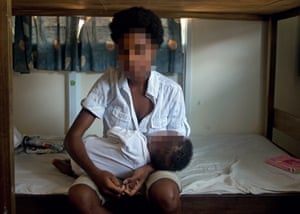
A woman and her child at a safe house in Papua New Guinea.
A woman and her child at a safe house in Papua New Guinea. Photograph: Jodi Bieber/MSF

Médecins Sans Frontières has warned the government of Papua New Guinea that its inadequate response to sexual violence is putting lives at risk.
In a report, published as MSF prepares to end a nine-year project addressing family and sexual violence, the organisation has called on the country’s leaders and international donors to address dangerous gaps in services and legislation.
“Inadequate or inappropriate responses from the country’s hybrid system of formal and traditional justice, and the dysfunction of the protection system, are putting survivors’ lives and health at risk,” says the report, Return to Abuser.


“Patients’ experiences expose a culture of impunity and a continuing reliance on traditional forms of justice to solve serious family and sexual violence cases.”
Human Rights Watch has called PNG “one of the most dangerous places in the world to be a woman or girl”. About 50-70% of women have experienced family or sexual violence.
MSF has treated almost 28,000 survivors of violence and performed more than 68,800 major and minor surgeries, one third for violence-related injuries.
MSF recorded data from more than 3,000 patients who came to clinics in the capital city of Port Moresby and the Highlands town of Tari over the past two years.
It found 94% of patients treated in the clinic after acts of violence were female, and 56% of sexual violence cases were children. Almost nine out of 10 sexual violence cases at the clinics involved rape.
Sticks, knives, machetes, whips and blunt objects were used in 69% of cases and 26% included death threats. More than a fifth of patients had major injuries.


The reception of the police station in Tari, Hela province, Papua New Guinea’
The reception of the police station in Tari, Hela province’. MSF family support centres have collaborated with police officers to protect survivors of violence. Photograph: Jodi Bieber/MSF

In Port Moresby, 70% of the clinic’s sexual violence cases were children, of whom 81% were under 15. Of that younger cohort, almost a quarter were under five. The office of the public prosecutor estimates that 55% of sexual violence cases that have reached the courts dealt with the abuse of children.
While much progress has been made by government, grassroots and international organisations, there are gaps.
A lack of safe houses leaves many women with no choice but to return home to their abuser after seeking medical help. PNG has six safe houses, all unregulated, private and unmonitored. Five are in the capital district and four have fewer than five beds.
None will take boys older than seven, which means mothers seeking shelter cannot take older boys.
More refuges are the obvious and urgent priority for the government, said MSF’s head of mission in PNG, Angelika Herb.
“Survivors reach family support centres … but there’s a huge lack of safe havens and survivors are forced to go back to their communities and partners. We are receiving the same survivors back in the family support centre.”
After seven years of review, the government last year passed its Child Welfare (Lukautim Pikinini) Act, which allows for the establishment of safe houses among other child protection measures. But it’s not yet certified and only four of PNG’s 22 provinces have been allocated budgets for the new law.
Since 2007, MSF has opened family support centres and clinics around the country where survivors can access first aid, psychological treatment, HIV and STI medication, vaccinations and emergency contraception.
Control of the family support centres is being transferred to the national health department. But the 16 centres are in urban areas. Around 85% of Papua New Guineans live in rural areas.
MSF has undertaken outreach work in remote communities to educate villagers about gender-based violence and discrimination against women.


Two years after criminalising domestic violence the government is still drafting relevant regulations, and “many officials are unwilling to commit to full implementation without regulations in hand”, said the report.
“Wider acknowledgement of the problem has not always translated into the practical action required to safeguard the lives, health and dignity of survivors of violence.”
The report calls for the government to take action on promised reform, stalled legislation and police training. It wants family support centres strengthened and essential services for sexual violence victims: free healthcare and ambulance services, along with better education, awareness, and transparency programmes.
Sebastian Roberts, the health department’s family and sexual violence coordinator, said coordination between government and external agencies is effective and improving, but intergovernmental cooperation and resources remain challenging.
“The commitment is there in terms of paper, but when it comes to funding we have a problem,” he says.
There have been some gains in the law and justice sector. In the past 12 years, the number of female village court magistrates recruited rose from 10 to 900, and the Australian department of foreign affairs and trade is working in the highlands to support village courts and other local authorities.
Ume Wainetti, national coordinator of the Family and Sexual Violence Action Committee, said there has been great progress but is concerned about what will happen when MSF ends its project.
“We are just fearful that many of these things may be left on the shelf if there is nobody there to make sure they’re being pushed and pulled to do them properly,” she said.
CITATION:

Davidson, Helen. "Papua New Guinea Risking Lives with Inaction on Sexual Violence, Says MSF." The Guardian. Guardian News and Media, 29 Feb. 2016. Web. 01 Mar. 2016. <http://www.theguardian.com/global-development/2016/feb/29/papua-new-guinea-risking-lives-sexual-violence-medecins-sans-frontieres>.

RESPONSE:

There are obvious concerns in Papua New Guinea that when Médecins Sans Frontières ends their nine year project against sexual violence, there will be little progress to protect victims in the future. Helen Davidson, the Australian based author of this article, is aiding MSF to secure the future of victims by calling on the PNG government and foreign aid agencies to take this cause seriously because lives are at risk.  Obviously, this is an extreme project to be taken on as Human Rights Watch stated that PNG " is one of the most dangerous places in the world to be a women or a girl". Such a statement highlights the need for action to be taken quickly. Davidson has a biased against the PNG government as she is aware of some progress being made but they need to take the issue of family and sexual violence serious. There is great concern that "many of these things may be left on the shelf if there is nobody there to make sure they’re being pushed and pulled to do them properly." Davidson states that two years ago the government criminalized domestic violence but has been slower to take action. The government officials could be reluctant to take on the job because it is a massive issue in PNG. Davidson addresses that one practical way for the government to begin focusing on would be the protection system. Most of the victims have to return home to potential get hurt again because there are no safe houses set up to protect them. This is an ideal starting point for the government.